This morning I woke up with the Cold Dreads. You may be familiar with them – they are the chattering list of all the things I need to do, finish, start, master, mail, decide, and pack before April 2012. We have drawn a line in the sand to push off then. April seemed a long way off when we made that decision, but the dates are rushing by and my list is longer now than it was three months ago. Land life keeps interfering with prep – you know: work, friends, Christmas, family, laundry, Wal-Mart, car maintenance…and all the stuff that needs fixing, maintaining, adding, cleaning, stowing, etc. on Raven.
I am a victim of adult ADD, and find myself rushing in six different directions, accomplishing a little here and a little there, but finishing nothing, which drives me to distraction. Hence the Cold Dreads. Because, that monkey mind insists, if you don’t do, finish, start, master, mail, decide, and pack, you will DIE.
Fortunately for me, I have been through this process before and I know how truly ridiculous it is. I well remember leaving our home, just for a long road trip, about eight years ago. You would have thought we were heading off into the wilds of Africa, we were so stressed. Leaving the dock in 2006 was the same. It will be the same this time, too. If I can just remember that once we push off (and I mean within the first 8” of clearing the dock) all this chatter stops and falls away and it’s just do the next thing, whatever that is.
Meanwhile, please excuse me. I have to work on that list.
Monday, October 31, 2011

Monday, June 13, 2011
Grinding toward Plan A
[Hilde's log]
Yes, this is my first post on this log in three years! To see why, visit my other blog: http://www.unedame.blogspot.com/.
David took the week off this last week for vacation. I use the term loosely, because we didn’t go anywhere and he worked the whole time. I did my regular work for various clients, but took off Friday and Saturday for a long weekend. David worked on boat projects, and that makes him happy. Makes me happy, too! I now have two shelves in one of my storage cabinets, which lets me actually see what’s in the cabinet without fear of causing an avalanche. We also now have two dry storage spaces in the v-berth for off-season clothes. We bought some (supposedly) air tight storage bags at Wally World yesterday, and I plan to put my winter stuff and land shoes in them and see what I can store. (I threw away two pairs of shoes….aaaaauuuugh.) We want all our personal items out of storage and on the boat, and off-season clothes have been a problem from the get-go.
We’re also getting the bimini, dodger, and mainsail cover replaced. They’ve gone from worn to shabby in the time we’ve spent here and it will be a relief to have them replaced. Once the dodger was off, I realized we needed to do the teak that it covers, so we’ve started on that. It’s hard, since summer is upon us and it’s 97 during the day. During the “vacation” we could put in an hour or two in the morning and another couple in the evening. It’s a slow go.
In fact, that’s what David remarked on, is how slowly projects go. He felt as though he hadn’t accomplished much, but I feel as though the barge has started to move, which is a good thing. We have a plan and we’re inching toward it. Before this past week, we had a plan that changed fairly regularly and had made no progress at all.
We have gone back and forth over staying or leaving. Our original plan was to come back to land, get good jobs, fill up the cruising kitty…so we came back to the worst recession in my memory, found $15/hr jobs and stayed even, more or less. We’ve gotten rid of probably 85% of our possessions. The last 15% is the killer. I spent 3 weeks scanning photos from 6 photo albums to clear out one more box.
David saw a story in one of the sailing magazines that started off “…so we sold everything and moved aboard.” What?! It’s taken us 8 years to get as far as we’ve come. Either they are lying through their teeth or they have no sentimental attachment to anything. Maybe their house was furnished in early Wal-Mart. It’s letting those cords to possessions die off that takes so long…I think I’m finally there. Well, I’m there until we go to storage and I see the This or the That which is irreplaceable and belonged to my mom. Ha.
But we’ve agreed to keep one smallish storage unit, 10 X 15, half for “garage stuff” (tools, etc.) and half for the oriental rugs, the silverware, the two end tables from the Middle East, the Arabic screen, etc. that I refuse to part with. Eventually, someday, we will be on land, due to being too old to get on the boat. Or eventually family members will settle down and want these priceless (to me) things.
But the rest goes. One. Thing. At. A. Time.
Yes, this is my first post on this log in three years! To see why, visit my other blog: http://www.unedame.blogspot.com/.
David took the week off this last week for vacation. I use the term loosely, because we didn’t go anywhere and he worked the whole time. I did my regular work for various clients, but took off Friday and Saturday for a long weekend. David worked on boat projects, and that makes him happy. Makes me happy, too! I now have two shelves in one of my storage cabinets, which lets me actually see what’s in the cabinet without fear of causing an avalanche. We also now have two dry storage spaces in the v-berth for off-season clothes. We bought some (supposedly) air tight storage bags at Wally World yesterday, and I plan to put my winter stuff and land shoes in them and see what I can store. (I threw away two pairs of shoes….aaaaauuuugh.) We want all our personal items out of storage and on the boat, and off-season clothes have been a problem from the get-go.
We’re also getting the bimini, dodger, and mainsail cover replaced. They’ve gone from worn to shabby in the time we’ve spent here and it will be a relief to have them replaced. Once the dodger was off, I realized we needed to do the teak that it covers, so we’ve started on that. It’s hard, since summer is upon us and it’s 97 during the day. During the “vacation” we could put in an hour or two in the morning and another couple in the evening. It’s a slow go.
In fact, that’s what David remarked on, is how slowly projects go. He felt as though he hadn’t accomplished much, but I feel as though the barge has started to move, which is a good thing. We have a plan and we’re inching toward it. Before this past week, we had a plan that changed fairly regularly and had made no progress at all.
We have gone back and forth over staying or leaving. Our original plan was to come back to land, get good jobs, fill up the cruising kitty…so we came back to the worst recession in my memory, found $15/hr jobs and stayed even, more or less. We’ve gotten rid of probably 85% of our possessions. The last 15% is the killer. I spent 3 weeks scanning photos from 6 photo albums to clear out one more box.
David saw a story in one of the sailing magazines that started off “…so we sold everything and moved aboard.” What?! It’s taken us 8 years to get as far as we’ve come. Either they are lying through their teeth or they have no sentimental attachment to anything. Maybe their house was furnished in early Wal-Mart. It’s letting those cords to possessions die off that takes so long…I think I’m finally there. Well, I’m there until we go to storage and I see the This or the That which is irreplaceable and belonged to my mom. Ha.
But we’ve agreed to keep one smallish storage unit, 10 X 15, half for “garage stuff” (tools, etc.) and half for the oriental rugs, the silverware, the two end tables from the Middle East, the Arabic screen, etc. that I refuse to part with. Eventually, someday, we will be on land, due to being too old to get on the boat. Or eventually family members will settle down and want these priceless (to me) things.
But the rest goes. One. Thing. At. A. Time.
Wednesday, October 15, 2008
Catching up
Hi! Everyone:
No, we haven’t fallen off the face of the Earth. Establishing ourselves in Corpus Christi (CC) has been frighteningly difficult and time consuming.
When Raven was in Clear Lake we dodged Hurricane Dolly that crossed the coast south of CC. We took our small travel trailer home to Canyon Lake, about 100 miles north. The winds shook us about some and it rained like crazy, but it wasn’t too bad.
I went to Clear Lake to work on Raven and was there for Tropical Storm Edouard, which turned out to be a non event.
Finally, Bill arrived from Dallas and we took Raven to CC. The forecast was for unsettled weather, but there were no storms in the offing, so we went. We caught the wind and tide just right for an easy passage through Galveston’s jetties, then turned SW. The port close reach was good sailing, but towards evening the winds dropped and would not keep the sails filled in the considerable chop that is frequently found along the north Gulf coast. The motor fired up fine, we dropped sails and settled in for the night.
Bill made a lovely salad for supper and we both chowed down eagerly. A little later I started to feel ill, then sick. I spent a miserable night and all of the next day with severe headache and nausea. I tried to pull my weight with boat duties but in any position except horizontal I was violently ill.
Just as quickly as it started, around 2200 hours the illness departed and I felt fine. I was ready to work and to eat. It was a miraculous recovery.
Poor Bill dropped into the bunk and caught up on some well-earned sleep. He kept things going when I was out of it and I greatly appreciate his help. Without him I would have had to heave to in a region of water where there are tens, if not hundreds, of oil platforms. This experience has re-framed any ideas I had about single-handing.
By the time I recovered, the wind had piped up and Bill had all sails flying. Raven was tearing along on a close reach. I kept things going through the night and by dawn we were off Port Aransas Pass. Rather than enter in the dark, we killed an hour reaching back and forth close the outer marks.
At first light we headed in and had a long but uneventful chug along the Gulf Intracoastal Waterway, past the Naval Air Station at Ingleside, to Corpus Christi.
It is impossible to disagree with Bill’s description of this experience as “the trip from Hell”. Still, he is ready to sign up again. The next trip just has to be better …
The trip down the coast loosened the rudder post stuffing box to the point that no further tightening stopped the inflow of water. The bilge pump was going off every five minutes. It was clearly time to properly fix this problem that Robinhood Marine in Maine was paid to fix two years ago. Once hauled out, I discovered that the stuffing material was old and fully compressed. Given this opportunity, I also replaced the obviously original 4” diameter rubber tube between hull and stuffing box. It was not leaking (yet!) but the rubber was perished and flakey.
North Shore Boatworks in Ingleside was a pleasure to deal with. They encouraged me to do the work myself and offered to help if I needed it. While they added new bottom paint, I fixed the stuffing box and serviced three seacocks. I should have done them all but it was extremely hot on the hard.
For some ridiculous reason I had been afraid to service seacocks. That two of them were seized added to my fears. Once the locking nuts were eased, a large hammer helped to free up one seacock and a tube slipped over the handle gave me enough leverage to free up another. Obviously I was careful not to apply too much muscle.
Dunking the parts in a muriatic acid solution cleaned of the scale and grime. I then lapped all valves and lubed them with Lucas “Red and Tacky” grease. I tried to get the recommended grease but NAPA no longer sells it. They recommended this as a replacement.
I quickly discovered that it is easy to over-tighten seacocks. In doing so the grease is squeezed out and lost, leaving metal-on-metal. In the end I abandoned all wrenches and used only my fingers to tighten the seacocks. I expected that they would leak upon re-floating and require tightening. They did not. So far, they are still easy to turn and have not leaked one drop.
The latest repair is to the 30A socket for shore power. The wires had become loose and had been arcing. We were lucky that they didn’t catch fire. This work is in progress. I have bought an extra 30A socket that is for only the heat pump. The 8AWG-3 wire is huge and perhaps overkill for the job. I am considering using #10 instead. More later.
Best regards to you all.
Captain Dave
No, we haven’t fallen off the face of the Earth. Establishing ourselves in Corpus Christi (CC) has been frighteningly difficult and time consuming.
When Raven was in Clear Lake we dodged Hurricane Dolly that crossed the coast south of CC. We took our small travel trailer home to Canyon Lake, about 100 miles north. The winds shook us about some and it rained like crazy, but it wasn’t too bad.
I went to Clear Lake to work on Raven and was there for Tropical Storm Edouard, which turned out to be a non event.
Finally, Bill arrived from Dallas and we took Raven to CC. The forecast was for unsettled weather, but there were no storms in the offing, so we went. We caught the wind and tide just right for an easy passage through Galveston’s jetties, then turned SW. The port close reach was good sailing, but towards evening the winds dropped and would not keep the sails filled in the considerable chop that is frequently found along the north Gulf coast. The motor fired up fine, we dropped sails and settled in for the night.
Bill made a lovely salad for supper and we both chowed down eagerly. A little later I started to feel ill, then sick. I spent a miserable night and all of the next day with severe headache and nausea. I tried to pull my weight with boat duties but in any position except horizontal I was violently ill.
Just as quickly as it started, around 2200 hours the illness departed and I felt fine. I was ready to work and to eat. It was a miraculous recovery.
Poor Bill dropped into the bunk and caught up on some well-earned sleep. He kept things going when I was out of it and I greatly appreciate his help. Without him I would have had to heave to in a region of water where there are tens, if not hundreds, of oil platforms. This experience has re-framed any ideas I had about single-handing.
By the time I recovered, the wind had piped up and Bill had all sails flying. Raven was tearing along on a close reach. I kept things going through the night and by dawn we were off Port Aransas Pass. Rather than enter in the dark, we killed an hour reaching back and forth close the outer marks.
At first light we headed in and had a long but uneventful chug along the Gulf Intracoastal Waterway, past the Naval Air Station at Ingleside, to Corpus Christi.
It is impossible to disagree with Bill’s description of this experience as “the trip from Hell”. Still, he is ready to sign up again. The next trip just has to be better …
The trip down the coast loosened the rudder post stuffing box to the point that no further tightening stopped the inflow of water. The bilge pump was going off every five minutes. It was clearly time to properly fix this problem that Robinhood Marine in Maine was paid to fix two years ago. Once hauled out, I discovered that the stuffing material was old and fully compressed. Given this opportunity, I also replaced the obviously original 4” diameter rubber tube between hull and stuffing box. It was not leaking (yet!) but the rubber was perished and flakey.
North Shore Boatworks in Ingleside was a pleasure to deal with. They encouraged me to do the work myself and offered to help if I needed it. While they added new bottom paint, I fixed the stuffing box and serviced three seacocks. I should have done them all but it was extremely hot on the hard.
For some ridiculous reason I had been afraid to service seacocks. That two of them were seized added to my fears. Once the locking nuts were eased, a large hammer helped to free up one seacock and a tube slipped over the handle gave me enough leverage to free up another. Obviously I was careful not to apply too much muscle.
Dunking the parts in a muriatic acid solution cleaned of the scale and grime. I then lapped all valves and lubed them with Lucas “Red and Tacky” grease. I tried to get the recommended grease but NAPA no longer sells it. They recommended this as a replacement.
I quickly discovered that it is easy to over-tighten seacocks. In doing so the grease is squeezed out and lost, leaving metal-on-metal. In the end I abandoned all wrenches and used only my fingers to tighten the seacocks. I expected that they would leak upon re-floating and require tightening. They did not. So far, they are still easy to turn and have not leaked one drop.
The latest repair is to the 30A socket for shore power. The wires had become loose and had been arcing. We were lucky that they didn’t catch fire. This work is in progress. I have bought an extra 30A socket that is for only the heat pump. The 8AWG-3 wire is huge and perhaps overkill for the job. I am considering using #10 instead. More later.
Best regards to you all.
Captain Dave
Thursday, August 14, 2008
Life in the old dog yet.
Hi! Everyone:
Mister P is running again. Initially, the idle was high (around 1200 rpm) but was easily adjusted to 750 rpm. The shop manual recommends 650, but I see no point in having the engine shake its mounts at that low speed.
It took several attempts to start. I bled air out of the fuel system but I was ignorant of the second bleed screw on top of the injector pump's “anti-stall device”. Raven’s pump is a hybrid of the two drawings in the shop manual, and neither showed this type of bleed screw. After talking with two other Perkins owners, I decided to loosen this screw.
But first … I had to modify an Allen wrench to fit between the screw and the heat exchanger. Have you ever tried to hacksaw through even a small Allen wrench? After twenty minutes I had barely scratched its surface. Friends on Brendan bailed me out with the loan of their Dremmel. (Mine is in storage, of course.) Unable to get any Allen wrench to fit, I had to guess which one to cut ¼” off. Third wrench was a charm.
Bleeding out the air was becoming second nature. Eventually, one cylinder fired, then another … Once all four were firing, I shut down the engine and opened the raw water seacock. I had closed it to keep from filling the wet muffler with sea water while I was repeatedly cranking a reluctant engine. Thankfully, I remembered to open it. In Bellhaven, NC, two years ago, I was so elated after effecting an engine repair that I forgot to re-open the raw water seacock, causing the engine to overheat, the cabin to fill with sweet-smelling steam from boiling antifreeze, and Hilde to go in search of Raven’s fire extinguishers.
When they are running well, diesel engines at idle sound like they have a heartbeat. It was almost as if I had breathed new life into some living beast. (Steam engine enthusiasts will easily understand this.) Naturally, I am very happy that there seems to be life in the old dog yet.
CD36 owners with the 4.108 engine and the one-piece, aluminum, Bowman casting that is a combined exhaust manifold, heat exchanger, and antifreeze header tank on the engine’s port side might be interested to know that this assembly can be removed and reinstalled without removing the injectors and the high pressure fuel lines. (Write me for details.)


Raven’s heat exchanger was designed with no zinc, so I added a bushing and pencil zinc at the rear of the casting. (On the right in the picture, just below the lazarette hinge.) It is easy to reach to check and replace, if necessary. I don’t know if I did it right, but the corrosion on the heat exchanger indicated that some sort of sacrificial zinc was necessary. (Write me for details.)
 The exhaust goose neck, from the rear of the manifold to the wet muffler was heavily rusted. It is made of standard 1½” galvanized plumbing pipe, elbows, and connectors. It has worked flawlessly for 24 years, so I can’t knock the design. To remove the rust, I first tried Naval Jelly. It did only “OK” so next I dipped it in muriatic acid, diluted 1:5 with water. This is nasty, nasty stuff. I was my first experience of it and, I hope, my last. For all that, it worked wonders on the exhaust pipe, removing the rust and calcium so that the original pipe threads are again visible. After neutralizing the acid in a bath of water and baking soda and allowing the pipe to dry, I wire-brushed it vigorously. The Houston air was so damp that surface rust began forming almost immediately, so I painted it with Ospho to stabilize the surface. The final coat is Duracolor’s high temperature, ceramic-based paint. It is rated up to 1200°F and sprays on like chromium plating. It was very satisfying to see the exhaust pipe shining like polished silver. I have run the engine over an hour already and the pipe is still shiny.
Diesel Parts Sales on Canal Street in Houston did an excellent job of rebuilding the pump and atomizers, and refurbishing the heat exchanger. They took the time to answer my questions patiently and willingly shared their encyclopedic knowledge of Perkins engines.
Now that all that is behind me, I hope to bring Raven to Corpus Christi next week. Watch this space for our progress.
Best regards,
Captain Dave
It took several attempts to start. I bled air out of the fuel system but I was ignorant of the second bleed screw on top of the injector pump's “anti-stall device”. Raven’s pump is a hybrid of the two drawings in the shop manual, and neither showed this type of bleed screw. After talking with two other Perkins owners, I decided to loosen this screw.
But first … I had to modify an Allen wrench to fit between the screw and the heat exchanger. Have you ever tried to hacksaw through even a small Allen wrench? After twenty minutes I had barely scratched its surface. Friends on Brendan bailed me out with the loan of their Dremmel. (Mine is in storage, of course.) Unable to get any Allen wrench to fit, I had to guess which one to cut ¼” off. Third wrench was a charm.
Bleeding out the air was becoming second nature. Eventually, one cylinder fired, then another … Once all four were firing, I shut down the engine and opened the raw water seacock. I had closed it to keep from filling the wet muffler with sea water while I was repeatedly cranking a reluctant engine. Thankfully, I remembered to open it. In Bellhaven, NC, two years ago, I was so elated after effecting an engine repair that I forgot to re-open the raw water seacock, causing the engine to overheat, the cabin to fill with sweet-smelling steam from boiling antifreeze, and Hilde to go in search of Raven’s fire extinguishers.
When they are running well, diesel engines at idle sound like they have a heartbeat. It was almost as if I had breathed new life into some living beast. (Steam engine enthusiasts will easily understand this.) Naturally, I am very happy that there seems to be life in the old dog yet.
CD36 owners with the 4.108 engine and the one-piece, aluminum, Bowman casting that is a combined exhaust manifold, heat exchanger, and antifreeze header tank on the engine’s port side might be interested to know that this assembly can be removed and reinstalled without removing the injectors and the high pressure fuel lines. (Write me for details.)
Raven’s heat exchanger was designed with no zinc, so I added a bushing and pencil zinc at the rear of the casting. (On the right in the picture, just below the lazarette hinge.) It is easy to reach to check and replace, if necessary. I don’t know if I did it right, but the corrosion on the heat exchanger indicated that some sort of sacrificial zinc was necessary. (Write me for details.)
The exhaust goose neck, from the rear of the manifold to the wet muffler was heavily rusted. It is made of standard 1½” galvanized plumbing pipe, elbows, and connectors. It has worked flawlessly for 24 years, so I can’t knock the design. To remove the rust, I first tried Naval Jelly. It did only “OK” so next I dipped it in muriatic acid, diluted 1:5 with water. This is nasty, nasty stuff. I was my first experience of it and, I hope, my last. For all that, it worked wonders on the exhaust pipe, removing the rust and calcium so that the original pipe threads are again visible. After neutralizing the acid in a bath of water and baking soda and allowing the pipe to dry, I wire-brushed it vigorously. The Houston air was so damp that surface rust began forming almost immediately, so I painted it with Ospho to stabilize the surface. The final coat is Duracolor’s high temperature, ceramic-based paint. It is rated up to 1200°F and sprays on like chromium plating. It was very satisfying to see the exhaust pipe shining like polished silver. I have run the engine over an hour already and the pipe is still shiny.Diesel Parts Sales on Canal Street in Houston did an excellent job of rebuilding the pump and atomizers, and refurbishing the heat exchanger. They took the time to answer my questions patiently and willingly shared their encyclopedic knowledge of Perkins engines.
Now that all that is behind me, I hope to bring Raven to Corpus Christi next week. Watch this space for our progress.
Best regards,
Captain Dave
Saturday, August 2, 2008
Re-entry
Hi! Everyone:
No, we haven’t disappeared. Re-entry to landlubber life has been chaotic and exhausting. Our belongings remain scattered in four Texas cities and seem to defy any attempts to gather them all in one place. I’m embarrassed to admit that our large storage unit was so full that when I opened the door stuff fell out. Now we have another, small storage unit so that I have some breathing room to shuffle stuff around and pack yet more into the main space. Sigh!
Raven has been taking a well-earned rest and demanding some TLC. She brought us safely to Clear Lake, TX, but stopped me in my tracks when I attempted to move her to Corpus Christi. Maybe she knew that Hurricane Dolly was coming and didn’t want to deal with that.
A friend had driven from Dallas to help me move Raven and all was going well until we were about half way out of the marina. Mister P (our workhorse Perkins diesel) began to run away. This is a technical term for “Oh, My God! Pulling the stop lever hasn’t stopped the engine.” I quickly ran below and cut off the air supply at the intake before the revs got very high, so at least it didn’t race at high rpm. TowBoatUS earned themselves the easiest tow they’ve ever had by taking us 700 yards back to the slip.
That was mid June. One month later, the injector pump and four injectors have been rebuilt. ($1250) The heat exchanger is being refurbished. (Probably another $200.) I’ll add details of the repairs in a later blog.
In the meantime, I’ve repaired the air conditioner ($400), so my life on Raven is again comfortable. I had spread awnings over the deck and tried to live without a/c, but when the outside air is in the nineties and still, it is miserable below deck. Cooking is out of the question and sleep is next to impossible.
Until the heat exchanger is ready for pickup, I am cleaning up the engine, the fuel lines, and the exhaust gooseneck. Final assembly should begin this weekend.
The plan is still to take Raven to Corpus Christi. The next full moon is August 16th and I hope to have all repairs finished well before then. A night sail along the coast can be a delightful experience. The oil platforms are surprisingly beautiful. They are compact, isolated cities at sea, brilliantly illuminated, and bustling with life. NOAA’s vector charts show all of these obstructions, including the enormous, unlit mooring buoys used by the service boats. The full moon adds an extra level of safety.
Captain Dave
No, we haven’t disappeared. Re-entry to landlubber life has been chaotic and exhausting. Our belongings remain scattered in four Texas cities and seem to defy any attempts to gather them all in one place. I’m embarrassed to admit that our large storage unit was so full that when I opened the door stuff fell out. Now we have another, small storage unit so that I have some breathing room to shuffle stuff around and pack yet more into the main space. Sigh!
Raven has been taking a well-earned rest and demanding some TLC. She brought us safely to Clear Lake, TX, but stopped me in my tracks when I attempted to move her to Corpus Christi. Maybe she knew that Hurricane Dolly was coming and didn’t want to deal with that.
A friend had driven from Dallas to help me move Raven and all was going well until we were about half way out of the marina. Mister P (our workhorse Perkins diesel) began to run away. This is a technical term for “Oh, My God! Pulling the stop lever hasn’t stopped the engine.” I quickly ran below and cut off the air supply at the intake before the revs got very high, so at least it didn’t race at high rpm. TowBoatUS earned themselves the easiest tow they’ve ever had by taking us 700 yards back to the slip.
That was mid June. One month later, the injector pump and four injectors have been rebuilt. ($1250) The heat exchanger is being refurbished. (Probably another $200.) I’ll add details of the repairs in a later blog.
In the meantime, I’ve repaired the air conditioner ($400), so my life on Raven is again comfortable. I had spread awnings over the deck and tried to live without a/c, but when the outside air is in the nineties and still, it is miserable below deck. Cooking is out of the question and sleep is next to impossible.
Until the heat exchanger is ready for pickup, I am cleaning up the engine, the fuel lines, and the exhaust gooseneck. Final assembly should begin this weekend.
The plan is still to take Raven to Corpus Christi. The next full moon is August 16th and I hope to have all repairs finished well before then. A night sail along the coast can be a delightful experience. The oil platforms are surprisingly beautiful. They are compact, isolated cities at sea, brilliantly illuminated, and bustling with life. NOAA’s vector charts show all of these obstructions, including the enormous, unlit mooring buoys used by the service boats. The full moon adds an extra level of safety.
Captain Dave
Monday, June 23, 2008
Weeeee're Back!
 Photo #1: Sunrise on the Gulf, one of the rewards for taking that 2 - 6 a.m. watch.
 Photo #2: Beautiful afternoon clouds, one of the rewards of taking a daytime watch.
[Hilde’s log]
I am sitting below decks mourning the death of our air conditioner. It passed away quietly our last day in Pensacola, and brother do I miss it. It’s 11:00 a.m. and 93 degrees. We must be back in Seabrook!
We had a challenging and beautiful passage from Pensacola to Galveston. If I were to title the trip, I’d call it Thunderstorm Alley. Four of our six days out were plagued with storms: huge, monstrous, glorious, terrifying, and beautiful. In addition to the thunderheads and lightening, we saw several water spouts. For contrast, two of the days we were out, it was just flat calm in all directions. We hardly sailed at all the entire trip and I was so glad we thought to add two extra cans of diesel fuel to the deck. We ended up using our entire tank, plus all we had on deck, and cruised into Galveston with 8 gallons left.
All the way across the Gulf from Pensacola our days were spent playing dodge ‘em with the mountainous thunderheads and our nights were spent playing dodge ‘em with lightening bursts. We were lucky, only coming close to one big storm. That was scary enough, as the black clouds converged on our position from two directions, churning five foot seas in every direction. With life jackets donned, we alternated between sitting on the cabin sole (me praying nonstop) and sticking our heads up to see what was going on. It was more scary looking than actually dangerous (other than the lightening), with top winds of only 34 knots. The lightening, though, was ferocious for the entire trip.
Cloud to cloud lightening would light up the sky for miles, illuminating the storm clouds and the sea. The “bad” lightening was the cloud to ground sort, enormous bolts visible for miles that stabbed the sea in sudden bursts. We measured the position of the night time storms from the cloud to ground lightening, and once we determined which way the storm was headed, we went perpendicular and ran like hell. You know the saying “There are old sailors and bold sailors, but no old bold sailors.” We intend to get old.
Out of Pensacola the storms chased us south so far that we totally gave up on the fairways and just headed out to deep water. It’s so much better far off shore anyway, because it takes a lot of wind to stir up deep water. The sky was magnificent, full of the Milky Way. Most of the time we seemed to inhabit a charmed circle of clear sky, with thunderheads all the way around us. All day long I’d watch them build and collapse, like soufflés in a nautical oven.
The most appalling storm was the one we encountered when we were about 100 miles out of Galveston. The sky in front of us (landward) was dark, featureless gray, like a gray blanket over the entire horizon. At sunset and we couldn’t see the sun at all until it touched the ocean, and then it was a vermillion fireball for a few seconds before disappearing. NOAA radio reported a huge thunderstorm galloping out the ship channel from Houston to Galveston to parts SW at 30 miles per hour. I was so glad we had made such slow progress across the Gulf; otherwise we might have found ourselves in the middle of that storm coming in. It was a huge system, spewing lightening from one side of the horizon to the other. We were relieved to watch it pass to the SW as predicted (we were headed NW) and we never even had any rain from it. Another storm threatened our starboard quarter for most of the night, but it eventually faded away to the NE. I have yet how to account for the movement of storms relative to the wind direction on the boat.
Thanks to our Fugawi charts (the best charts, as far as I can tell) we knew to follow the shipping lanes (called the fairways) along the coast once we passed South Port, Louisiana, and so it was easy to stay away from the oil wells, the supply boats and the truly enormous mooring balls used by the supply ships (easily the size of a Hummer). The wells are really beautiful at night, lit up like casinos – provided they are lit up. There are occasional wells that are not lit, and those are the scary ones. That’s one reason we have made both our Gulf crossings under a full moon. We saw two unlit wells this trip.
I am sitting below decks mourning the death of our air conditioner. It passed away quietly our last day in Pensacola, and brother do I miss it. It’s 11:00 a.m. and 93 degrees. We must be back in Seabrook!
We had a challenging and beautiful passage from Pensacola to Galveston. If I were to title the trip, I’d call it Thunderstorm Alley. Four of our six days out were plagued with storms: huge, monstrous, glorious, terrifying, and beautiful. In addition to the thunderheads and lightening, we saw several water spouts. For contrast, two of the days we were out, it was just flat calm in all directions. We hardly sailed at all the entire trip and I was so glad we thought to add two extra cans of diesel fuel to the deck. We ended up using our entire tank, plus all we had on deck, and cruised into Galveston with 8 gallons left.
All the way across the Gulf from Pensacola our days were spent playing dodge ‘em with the mountainous thunderheads and our nights were spent playing dodge ‘em with lightening bursts. We were lucky, only coming close to one big storm. That was scary enough, as the black clouds converged on our position from two directions, churning five foot seas in every direction. With life jackets donned, we alternated between sitting on the cabin sole (me praying nonstop) and sticking our heads up to see what was going on. It was more scary looking than actually dangerous (other than the lightening), with top winds of only 34 knots. The lightening, though, was ferocious for the entire trip.
Cloud to cloud lightening would light up the sky for miles, illuminating the storm clouds and the sea. The “bad” lightening was the cloud to ground sort, enormous bolts visible for miles that stabbed the sea in sudden bursts. We measured the position of the night time storms from the cloud to ground lightening, and once we determined which way the storm was headed, we went perpendicular and ran like hell. You know the saying “There are old sailors and bold sailors, but no old bold sailors.” We intend to get old.
Out of Pensacola the storms chased us south so far that we totally gave up on the fairways and just headed out to deep water. It’s so much better far off shore anyway, because it takes a lot of wind to stir up deep water. The sky was magnificent, full of the Milky Way. Most of the time we seemed to inhabit a charmed circle of clear sky, with thunderheads all the way around us. All day long I’d watch them build and collapse, like soufflés in a nautical oven.
The most appalling storm was the one we encountered when we were about 100 miles out of Galveston. The sky in front of us (landward) was dark, featureless gray, like a gray blanket over the entire horizon. At sunset and we couldn’t see the sun at all until it touched the ocean, and then it was a vermillion fireball for a few seconds before disappearing. NOAA radio reported a huge thunderstorm galloping out the ship channel from Houston to Galveston to parts SW at 30 miles per hour. I was so glad we had made such slow progress across the Gulf; otherwise we might have found ourselves in the middle of that storm coming in. It was a huge system, spewing lightening from one side of the horizon to the other. We were relieved to watch it pass to the SW as predicted (we were headed NW) and we never even had any rain from it. Another storm threatened our starboard quarter for most of the night, but it eventually faded away to the NE. I have yet how to account for the movement of storms relative to the wind direction on the boat.
Thanks to our Fugawi charts (the best charts, as far as I can tell) we knew to follow the shipping lanes (called the fairways) along the coast once we passed South Port, Louisiana, and so it was easy to stay away from the oil wells, the supply boats and the truly enormous mooring balls used by the supply ships (easily the size of a Hummer). The wells are really beautiful at night, lit up like casinos – provided they are lit up. There are occasional wells that are not lit, and those are the scary ones. That’s one reason we have made both our Gulf crossings under a full moon. We saw two unlit wells this trip.
The fairways are like sea going freeways, and are used by the commercial ships as they go to and fro. They are great to follow, because when you see a big ship coming, you pretty much know which way it is headed. We had one oil tanker cut behind us and two cut in front of us, but other than that they all behaved themselves and chugged down the road. The commercial traffic on the Gulf is terrific when you are within 100 miles of shore. We had forgotten! It was a lot like driving through a well populated country area on a highway, with the lights of the farm houses scattered all around and the lights of the 18 wheelers going up and down the road with you. Many of the captains are not native English speakers, so when you are trying to listen to the traffic on 16, language can be an issue. Actually, language is an issue when you listen to the barge traffic on the GIWW. Those men all speak with a weird southern patois/good old buddy accent that I am hard pressed to understand, and I’m from here.

Photo #3: This is what the lit oil rigs look like at night...

Photo #4: This is what they look like in the distance during the day (see that little spot?)...
 Photo #5: This is what they look like up close...
 Photo #6: And this is what they look like when I am not paying attention on watch and we get too close! Note the supply boat at right. That boat is enormous and it is dwarfed by the rig.
All the way across I was thrilled to be back on the Gulf. I grew up in Houston, and the Gulf is “home.” The sky looks right, the water looks right, the oil rigs look right – well, you know how home is, warts and all; there's no place like it. The Gulf is also one of the most beautiful places on earth, whether you are dodging oil wells near shore or are out on the flat expanse of blue that opens up about 150 miles out.
It was great fun to come into Galveston, despite our grueling passage in. Contrary wind and current made the water rough and because the blasted self steering died about 30 miles from the outer mark, we had to hand steer, one hour on and one hour off, for the next 12 hours. The good news is that it was blessedly cool from all the storms that passed through before we got in. We motored down the gauntlet of at least 50 ships at anchor on either side of the fairway, waiting to be called in to the Port of Houston. Raven reached the jetties about 7 a.m. and caught a rising tide into the bay. We had the yankee out and the engine on and she scooted through the jetties at 8.3 knots, past the anchored tankers and into the anchorage at Teacup, where we pulled into the closest marina for fuel. There were a couple of fishing boats tied up as well, and the fishermen and women were cleaning a catch, surrounded by a screeching cloud of gulls, pelicans, and cormorants. The birds were busy catching and eating the culls from the catch (which looked like eels), literally pulling them out of each others’ mouths.
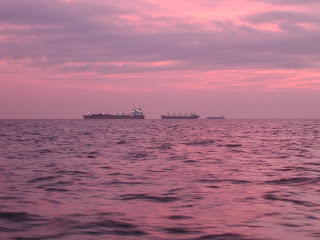 Photo #7: Three of the over 50 anchored ships we passed just off the fairway near Galveston in dawn's early light.
 Once we filled up with diesel we eased back out into the anchorage at Teacup and David checked the oil. Then we headed north up the channel for four hours to the anchorage at Red Fish Island where we spent a very hot afternoon and evening. Then this morning we came in, and our first slip at Watergate was awful. They are obviously waiting for the next storm to take out those docks, which were old, narrow, fixed, wooden, and full of splinters. Ick. David got us moved temporarily to the new floating docks, which is a much better location and easy step on-off to Raven's deck.
 Photo #8: Boats anchored at Red Fish Island. The island is man-made (spoil) so there is no vegetation, no shade, and no bugs. You do have a great view of the channel traffic, as you can see. The wake from these huge ships washes over the island like the surf over the rocks on the West Coast!
 It was so much fun to sail (no, motor, the wind never did cooperate) up the channel and into the bay and under the Kemah bridge. All that trip used to just terrify me and it was fun coming in and recognizing everything and not being a bit scared. Just hot. It is, after all, Texas in June.

Photo #9: Oh my gosh! It's me, steering Raven across the bay and I actually know what I'm doing! Notice the kerchief - it's soaked in ice water. It's hot.

Photo #10: then we see the Kemah boardwalk... (new roller coaster there!)

Photo #11: under the Kemah bridge...

Photo #12: Where it all started, two years, two months and 8 days ago. Our slip was opposite "Tres Amigos" here in Seabrook. Unfortunately, they were full, so we are docked at Watergate, just up the way.
Monday, June 16, 2008
Heading Out
[Hilde’s log]
We’ve enjoyed Pensacola and the splendid hospitality of our friends John and Cookie, who showed us the sights, fed us, introduced us to new friend Joyce, and even made a loan of their second car. Such luxury! It’s hard to leave friends and a lovely city and wheels, but go we must. Raven’s air conditioning bit the dust last night, and I must admit that makes it easier to push off. It was a Turkish bath in the cabin as I cooked a few meals for us to take as we head out into the Gulf tomorrow and we’ve been hanging out in the cockpit waiting for it to cool off enough to go to bed…maybe soon. It’s still 84 down here.
We will be travelling on the outside as we make our way back to Texas, down the shipping lanes, a journey of about 500 miles. Hopefully we will be chugging under the Kemah bridge in about six days. We will have a full moon and a good weather window, so we hope for a pleasant journey. We’ll be staying at the Watergate Marina at Clear Lake for about a month, and then we anticipate a move to Corpus Christi Municipal Marina, so if you pass our way, let us know. Until then ~ here’s to your dreams.
We’ve enjoyed Pensacola and the splendid hospitality of our friends John and Cookie, who showed us the sights, fed us, introduced us to new friend Joyce, and even made a loan of their second car. Such luxury! It’s hard to leave friends and a lovely city and wheels, but go we must. Raven’s air conditioning bit the dust last night, and I must admit that makes it easier to push off. It was a Turkish bath in the cabin as I cooked a few meals for us to take as we head out into the Gulf tomorrow and we’ve been hanging out in the cockpit waiting for it to cool off enough to go to bed…maybe soon. It’s still 84 down here.
We will be travelling on the outside as we make our way back to Texas, down the shipping lanes, a journey of about 500 miles. Hopefully we will be chugging under the Kemah bridge in about six days. We will have a full moon and a good weather window, so we hope for a pleasant journey. We’ll be staying at the Watergate Marina at Clear Lake for about a month, and then we anticipate a move to Corpus Christi Municipal Marina, so if you pass our way, let us know. Until then ~ here’s to your dreams.
Subscribe to:
Posts (Atom)