Showing posts with label traveling the ICW. Show all posts

Wednesday, June 13, 2018

Summertime

[Hilde’s log]

We’re beach weanies. I’m not much on sand (it’s hard to walk through and gets everywhere) and David doesn’t like the heat. Neither of us has much urge to swim in opaque water and be nibbled by anonymous critters. So we wandered out on Wrightsville Beach, took a couple of snaps, and wandered right back into town.


Wrightsville Beach - gorgeous white sand and hot white sun.

Then we found out that the only attractions at Wrightsville Beach are the water and the beach. David solved that problem by fitting out the sailing kit for the dinghy, and we spent a couple of hours sailing up and down the anchorage. He sails; I’m ballast; we both have fun!

Sunset at Wrightsville Beach.

A long, 40-mile day found us at anchor off Camp LeJeune at Mile Hammock Bay. We were so bushed, the occasional ordnance fire didn’t keep us awake at all. Early in the morning, smoke from fires set off by the “war games” woke us. It’s a nice anchorage, despite the army activity, and it was a relief to be able to stop for the night.

Our next stop was Swansboro, where the anchorage was shallow, but gave us a good view of the town, the highway, and various restaurants. We spend three nights there. Our second day, we dinghied in for breakfast at Yanna’s, which was spilling over with customers. A walking tour of the town took up the rest of the morning. That evening we dinghied in the opposite direction and treated ourselves to a fine Mediterranean meal. 


We admired this house's beautiful garden.

One of the streets in the historic district, Swansboro.

Stormy skies over Swansboro. This one blew past us without even a sprinkle.


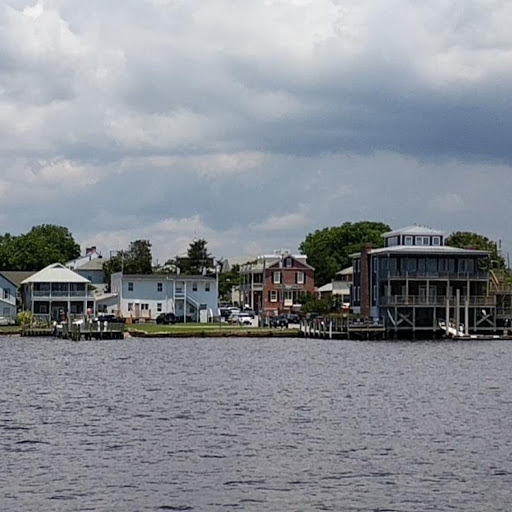
Swansboro - view from the water.

Here we are in the anchorage...before I ran us aground.

Our third day was not planned. As we were leaving the anchorage, I managed to ground us (again – this is my third time, I think; I am losing count) and we spend the entire frustrating day on board sweating and waiting for the shallow tide to rise and lift us off, which it did about 4 p.m. We went into the fuel dock for diesel and turned back to the anchorage for another night. Fortunately, David has a program on his phone that shows the contours of the bottom (sonar charts), so he downloaded this anchorage and we were able to leave without further ado the next morning.

The next day was another long trek, from Swansboro through Bogue Sound, past Moorehead City, and up Adams Creek. I remembered the anchorage at Moorehead City and was glad we didn’t have to stop there. It’s narrow and crowded and bad holding. We zipped past the town like a cat with its tail on fire: the current was running at 2.2+ knots with us and Raven flashed along at over 7 knots. That’s fast for us.

Underway from Swansboro under a beautiful summer sky. We have the jib out to give our speed a boost.
One of the huge working ships at the dock at Moorehead City. Check out the "little" boat (probably 20 feet long)  running along beside for a size comparison.

I love Bogue Sound. It’s a wide, wide expanse of water which is a delight in mild wind. We passed numerous pockets of tiny silver fish that flittered and leaped about on the surface of the water, creating water-borne glitter. I fantasized they were playing in the sun, but I’m pretty sure they were trying to avoid being lunch for the dolphins that surrounded us. 


The sound is broken up by islands and sand bars and coves. Houses line the shores, but they are so far away it doesn’t feel crowded. We passed one couple who had pulled their runabout up on a sandbar and debarked a couple of folding chairs and two excited dogs who ran back and forth on the bar, splashing and snapping at the water. Great idea! Pull up to your own little island and let the dogs run while you read the paper.

Neither of us remembered the views on Adams Creek, except we are both pretty sure it wasn’t built up ten years ago. Now there are three story houses on both sides of the Creek for quite a way. They finally peter out near the Neuse River. Cedar Creek is just a little south of the Neuse; Oriental is just across the Neuse River.

Arriving about 4 p.m., we anchored in 7 feet of water and spent a pleasant evening watching the world chug down the ICW. Fishing trawlers motored up and down with their nets out, and at one point two barges converged, one from either end of the channel. We were very glad to be anchored and not playing tag with those behemoths. When we came in, a lone catamaran was anchored near the shore. One other sailboat came in about an hour after we arrived, and then all was quiet.
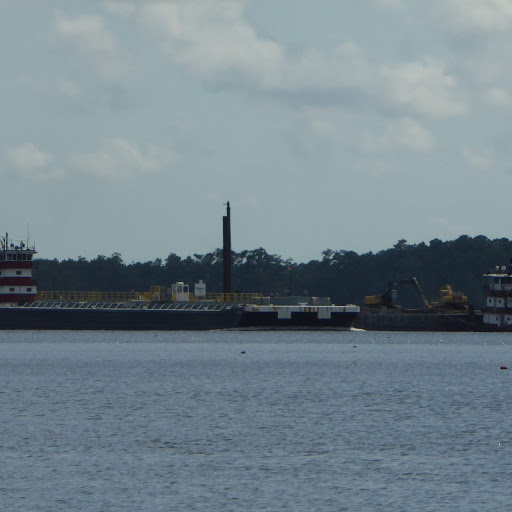
Nose to nose barges on the ICW off Cedar Creek.

We ended up sharing space with an entire commercial fishing fleet. They were the fishing trawlers we had been watching - seven boats that went in and out of their marina all afternoon and well into the evening, followed by a cloud of squawking gulls. In addition to the lone sailboat that anchored near us, the morning light revealed four more sailboats rafted up near us, flags flying gaily in the breeze. They took off later in the morning, but were replaced in the rainy afternoon by another three sailboats and a catamaran. We saw more sailboats at Cedar Creek than we’ve seen in the last two months!

We broke out the dinghy again and sailed all over the little bay. About eleven a.m. we heard thunder, and about noon a huge mass of black clouds appeared and roared through the anchorage bringing heavy rain and blessedly cool temperatures. The storm whooshed past, but left gray skies and constant rain for the rest of the day. It was a blessing – it was finally cool enough for me to cook something in the galley.

Rainy day on Cedar Creek.

It feels good to be back in North Carolina. It’s like East Texas with a lot of water. A lot of water. Last night I lay awake and listened to whip-poor-wills call in the trees; the air smells like wet pines. I am excited to be on the way to Oriental for a few days and then on to New Bern. We lived in New Bern for a year and we are both anxious to see how it has fared and whether we still feel at home there.

Friday, May 25, 2018

Blessed Quiet

[Hilde’s log]

Our path from Beaufort took us from the Beaufort River north up the Coosaw River, across St. Helena Sound, then through the Ashepoo-Coosaw cutoff (where we stopped short to avoid being creamed by a giant container ship) to the Ashapoo River. Angling through the Fenwick Cut, we anchored in about 20 feet of water in the South Edisto River, beside Fenwick Island. I keep these details because, although we know we came down this way ten years ago, I have absolutely no memory of the area, other than one or two anchorages that have stuck in my head. So this time I am keeping track. Off Fenwick Island, we anchored next to friends Ann and Tony on Stella Maris. The next morning, they set off for Charleston, but the area was so incredibly calm and beautiful we couldn’t bear to leave, so we spent a lovely day floating alone, marshes and woodlands on either side of the wide expanse of water.

The birds in the trees sang all day.

A glorious break of day.

This whole area is gorgeous and makes the trip worthwhile. As a refugee from a metropolitan area of over 12 million, and as a life-time reluctant city dweller, I delight in the absence of human buildup. There are houses scattered over these islands, but they are not, for the most part, intrusive, and many areas seem deserted (I know they aren’t, but I pretend).

Anchoring in a remote area is so restful to the soul. My favorite time of day is the early morning, when the soft, cool morning air is filled with birdsong from the neighboring trees and the only other sound is the gurgle of the current against Raven’s hull, the slap of waves on the nearby shore, and the croak of the occasional frog. Air that has only been breathed by trees and the sea is simply intoxicating, like a crisp chardonnay for the lungs. The absence of all sounds of mechanization makes me go limp with relief. We can usually enjoy about two hours of “silence” before the fishing boats break into our little cocoon of quiet. I am ridiculously territorial, resenting any intrusion by anyone into our solitude.


The next leg of the trip took us from the South Edisto River through Watts Cut to the Dawho River, which spills into the North Edisto River. That turns into Wadmalaw Sound, and we turned off there to anchor in Church Creek. As we left our anchorage across from Fenwick Island, we noticed quite a build up of black clouds to the west. A check of the radar revealed a nasty little clump of rain cells that was passing us to the north and west. It dogged us all day, sometimes nearer, sometimes farther away. Only one shower found us, but I couldn’t believe the rainstorm was moving as slowly as we were. There was no lightening, so it wasn’t scary – in fact, made for pretty good pictures!


I should mention here that David is our resident photographer. If you see a good photo, he’s usually the one who took it. I get lucky sometimes, but often steal his shots as they are usually better than mine. Credit where credit is due! Also maybe this will poke him to do a blog entry. (Ahem.)

Typical pose of our resident photo-guru.

Today as I write this, we are at anchor in Church Creek, one of seven boats who chose to spend the night here. Yeah, crowded. Sigh. You will see how silly I am when you see how far the other boats are from us, but still. We are waiting for the tide to rise, as some of these cuts are notoriously shallow – so why stress?

Our "crowded" anchorage in Church Creek. We were one of seven boats.

This morning as we had our tea on deck, we think we heard a loon call. Google informed us that yes, there are loons as far as South Carolina in May. I was amazed; I thought they stayed in the far north. Other informative tidbits: they are a very large bird (5 foot wingspan), are not related to ducks, have solid bones, and have been around for about 65 million years.

Morning tea. Side order of foot, optional.

Saturday, December 15, 2007

Awendaw, SC to Beaufort, SC 12-11 to 12-13, 2007


[Hilde's log]
Some places on the earth are so serene, so quiet, so still, I can hear the blood beating in my ears. It’s hard to get away from the sound of motors. Cars whosh, wires whine, lawnmowers growl, outboards putter, boats chug. On the boat, the chugging gets to me after a while, but there’s no alternative on the ICW. It’s far too narrow and far too shallow for any sailing, so we chug, chug, chug like the African Queen down the canals, watching the scenery pass by. Not that that’s unpleasant. It’s quite like sitting on your porch on a sunny fall day, as the world rolls past the steps. But the constant noise makes the silence of anchoring very, very sweet.

Four nights ago we dropped anchor in Awendaw Creek. There is an Awendaw, SC, which you can find in your atlas. The town is not far from this anchorage. You’d never know it, though. The ICW passes between two national parks right before you get to Awendaw Creek, the Frances Marion National Forest and the Cape Romain National Wildlife Refuge, so there’s a lot of scenery blessedly empty of human construction for several hours before you turn south into the creek. The creek is the size of a river in Texas (the size of the rivers in the Carolinas continue to astonish me), maybe 400 yards wide, a crescent of blue water bordered by gold and russet marshland, opening out into an even larger body of water that looked like the sea. By the time we’d taken care of the anchoring and the trip to shore (“shore” being a euphemism for mussel shoals, gooey, sticky mud, and acres of slough grass) for the dog, it was evening, darkening into night. The shoreline was fading away into mist and fog. The air and water were so still the stars were reflected beneath us.

The stillness lingered through the morning, as the night’s fog slowly burned off under the rising sun. Raven looked like a toy boat glued to a mirror. Her mast and hull, the surrounding marshland, the deep blue sky, and the last shards of dark grey fog were reflected perfectly in the water. As we motored toward the inlet, our wake creamed the water’s reflection into rolling fragments. And then, amazingly, we turned the bend and emerged from the wilderness next to a beautiful little waterfront community, with houses, trees, boats, and a camping area. The air was as crisp and sweet as a green apple, spiced with the scent of woodsmoke from the outdoor fires at the campground. What a perfect time to be outdoors and on the move.

That perfect sunny day melted into the next as we wandered down the waterway, which was sometimes perilously shallow, sometimes amazingly wide, sometimes populated, sometimes barren. The borders of the waterway were all marsh, rough yellow grass shot through with small inlets or streams stretching back to more solid ground covered with forest. In the foreground were live oaks, their branches twisted in fantastical shapes, then palms, their fronds light green pinwheels against the darker background stands of pines.

As we approached each populated section of the ICW, houses would appear on the landward shore, each house with its own 300 foot pier, long strands of wooden walkway ending in a boat house or a gazebo or both. Some of the gazebos were furnished for the next dock party with dock boxes, hammocks, freezers, fish tubs, lawn chairs, and ice chests. Others were empty, waiting for summer to roll around again. Birds roosted everywhere, but seemed especially happy to congregate on long private piers. Segregated by species, they seemed content to sit and watch us motor by. We’d pass clusters of four or five isolated pilings, in upright groupings like candles on a drowned cake, each piling topped with its own large bird. I wondered if the piers and pilings were safer roosts for the birds than spending the nights in the wild. Surely a bird sitting in the marsh grass would tempt any predator to pounce. As we passed the curve of these waterfront communities, the piers slipped by like the fingers of a hand. Then they’d be gone, and we’d be back in the marshes.

We motored across Charleston harbor, pointing happily at the places we remembered from our two week stay two summers ago. After a night parked in front of some beautiful and very expensive homes just to the west of town we journeyed the next day through the same warm, blue sky. No one could bear to go below for more than a few minutes before popping back up for more of the heady air and clear sky.

The last few miles of our day found us creeping carefully through some pretty shallow water at dead low tide, so we were thankful to turn off the waterway at last to the deep and serene South Edisto River. Anchored in 16 feet of water, we spent another silent night under a sharp black sky studded with fiery stars. The morning brought more fog, but it burned off quickly and we were underway for Beaufort, SC by 9 a.m. today.

That day’s trip took us across an absolutely enormous river, the Combahee, which had to have been five miles across. I say that because I was at the helm for over an hour at 5 knots, our course was almost a straight line, and when I surrendered the helm to David after my hour we were still on that river. Raven sped across the blue prairie in the stiff wind while I gloried in the view. The water spread out in all directions almost to the horizon and it was all I could do to turn away from the Atlantic outlet and head toward Beaufort. It was a quick travel day. We passed under the Lady Island Bridge in Beaufort at 2:30. Three o’clock saw us anchored. We took an evening stroll down the waterfront and then spent 30 minutes on deck admiring the harbor, the lights of the city, and yet another gorgeous sunset. I am amazed at how many sunrises and sunsets I have missed in my life. I was always getting ready for work, or driving, or fixing dinner, or something, but I was not seeing the sun rise or set. On the water, I hardly ever miss either, and I remain fascinated.

Wishing you lots of sunrises and sunsets and moments to savor!